
Inside Madison County Property Tax Records
Madison County splits the tax record between two offices. The Assessor identifies taxable parcels, sets annual market value, maintains the rolls, and handles the first review of a valuation. The Treasurer handles the bill. It collects payment and tracks delinquency and tax-deed files. Keeping that division clear prevents a payment screen from being mistaken for a complete parcel history.
| Record item | What it answers | Custodian |
|---|---|---|
| Annual value and roll | Value date, roll year, category, and assessed amount | Madison County Assessor |
| Exemption or reduction | Relief reflected in the assessment and bill | Assessor and Idaho Tax Commission |
| Bill and payment ledger | Tax year, halves due, payment, and balance status | Madison County Treasurer |
| Protest record | Notice, evidence, Board decision, and later review | Assessor, Clerk, and Board of Equalization |
| Tax-deed trail | Notices, affidavit, publication, redemption, and sale | Treasurer, Recorder, and commissioners |
An assessed amount is not a sale price. Madison County derives it from cost, income, and market approaches, depending on the property. A recorded deed can tell a different story. It captures what a buyer actually paid. The two figures rarely match, and that gap is normal. Value labels in the tax roll carry their own meanings. The Madison County property value guide breaks each one down in plain terms.
Madison County Tax Office Split
Pick the office by your question. Ask the Assessor what a parcel is worth, which roll carries it, whether it was inspected, or why a value moved. Ask the Treasurer what was billed. That office also tracks whether a half was paid, how interest posted, and whether a delinquency entered the tax-deed process. One office values; the other collects.
Assessor
Call 208-359-6200, Option 3, or visit 134 E Main in Rexburg for property cards, valuation files, rolls, notices, and review.
Treasurer / Tax Collector
Call 208-359-6200, Option 5, at the same county address for bills, ledgers, payment, delinquency, redemption, and tax-deed files.
Bring the parcel number and tax year. An address alone can change or match several parcels. The parcel key lets staff find the same account across the GIS map, the roll, and the tax ledger.
Madison County Property Tax Calendar
Madison County's tax calendar splits the year into two payment halves. The first half comes due December 20. The second is due June 20. A first-half balance turns late on December 21, and a second-half balance on June 21. The county posts a 2% late charge plus monthly interest rules, though owners should confirm the figures for their own tax year.
| Calendar point | Tax-record event | Best check |
|---|---|---|
| January 1 | Value date for the assessment year | Assessor roll |
| April 15 | Homeowner and circuit-breaker application deadline | Assessor |
| Fourth Monday in June | Last day listed to protest value | Current assessment notice |
| June 20 / December 20 | Second-half / first-half due dates | Treasurer bill |
| March 1 | Tax-deed process begins for third-year delinquency | Treasurer file |
Dates can shift in application for weekends, holidays, or a later official calendar. Keep the year of the notice you relied on. A standing calendar is not proof for every bill.
Madison County Property Tax Payment Portal
The county-linked OTC service works late in the process. It takes payment only after you already hold the parcel and bill details, with fields for the parcel number, the half or full year, an account name, a phone, and an optional note. No general owner search exists. No address or tax-history search exists either. Find the parcel number in MRGIS or on the bill, then verify the amount with the Treasurer before submitting funds.
| Payment field | How to use it |
|---|---|
| Parcel number | Copy the parcel identifier exactly from MRGIS or the bill. |
| Half / full year | Select the installment the Treasurer says is due. |
| Account name and phone | Provide payer details for the transaction. |
| Optional note | Add a short payment reference, not a request for research. |
View the county-linked OTC payment fields before using the form.
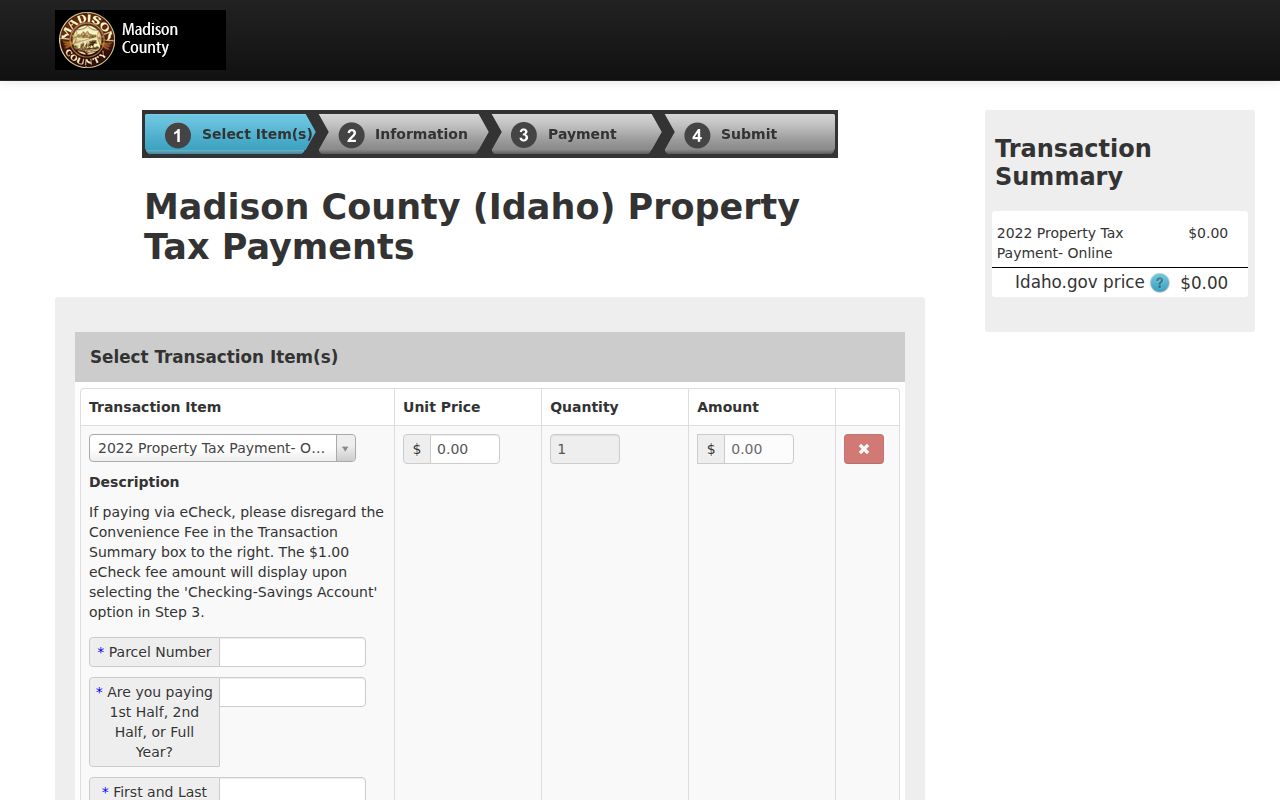
The payment page itself shows the limit plainly. It starts from a known parcel number, not from a Treasurer ledger request.
Madison County Property Tax Valuation
Madison County assesses all property at market value each year and physically inspects each parcel once in a five-year cycle. Appraisers may use cost, income, and market approaches. The county keeps four rolls. They are the main, subsequent, missed, and occupancy rolls. That variety matters. A new structure or corrected parcel can appear on a different notice schedule from a long-standing home.
The Idaho ratio study measures assessment level, uniformity or equity, and reliability. Madison County explains that assessed values should generally fall from 90% to 110% of market comparisons. That range is context, not a promise. One parcel's assessed value need not equal its next sale price.
Read the Assessor's assessment method alongside the annual notice.
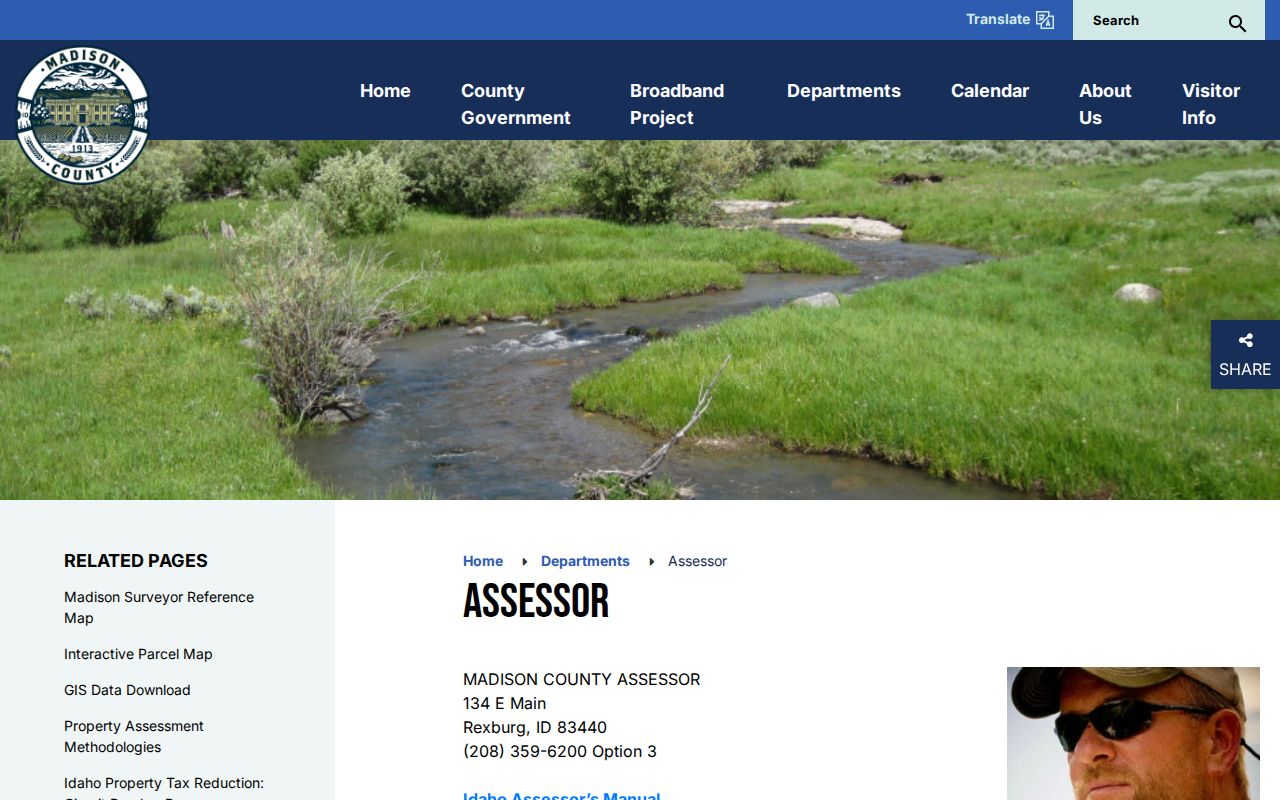
The official page ties each value to a roll and a review process. A dated property card thus beats an undated estimate.
Trace Madison County Property Tax Bills
Treat the address as a starting clue only. Preserve each identifier and source date as you move from the map to the custodian record.
- Search MRGIS by address and select the correct parcel polygon.
- Copy the
PARCEL_ID, legal description, and jurisdiction from the parcel card. - Ask the Treasurer for the bill or ledger for the named parcel and tax year.
- Compare each half, posting date, balance, and oldest delinquency shown.
- Check the Assessor's property card and roll for the value and relief underlying that bill.
- Request a written tax-deed or protest file when the ledger points to one.
- Assessed value
- The value placed on the county assessment roll for the applicable year.
- Levy
- The combined taxing-district charge applied through the tax process.
- Homeowner exemption
- Idaho relief for a qualifying owner-occupied home, applied through the Assessor.
- Tax lien
- The public claim tied to unpaid property tax, which requires current custodian confirmation.
Madison County Property Tax Relief
Idaho's property-tax reduction program is applied for through the county Assessor. For the 2026 program, the Tax Commission lists a reduction from $250 to $1,500. The homeowner exemption is required. So is 2025 income of no more than $39,130. Ownership and occupancy must come before April 15. Eligible categories include age 65 or older, blindness, widowhood, disability, former prisoner-of-war status, or hostage status.
Those figures belong to that program year. Check the current Idaho property-tax reduction page and file from January 1 through April 15 with the Madison County Assessor. The benefit shows up on the December bill. It does not reduce certain solid-waste or irrigation charges.
Keep the application year, proof submitted, Assessor decision, and bill showing the benefit together as one record set.
Contest Madison County Property Tax Assessments
Begin with the Assessor. Request the property record card, the valuation approach, and the comparable-sales material. Ask also for inspection notes, roll year, and notice. Point to a concrete error or unequal treatment. Do not simply ask for a lower figure you prefer. Try the informal review first. When it does not settle the matter, the Board of Equalization hears the protest next. The board is made up of the county commissioners. Board appointments run through the County Clerk. The county calendar marks the fourth Monday in June. That is the last day to protest value. A later challenge may go to the State Board of Tax Appeals or District Court. Confirm the live deadline and filing directions on the current notice, because the record's year controls.
Protect the appeal window. Contact the Assessor at once, then verify the Board filing date with the Clerk before relying on a calendar summary.
Madison County Property Tax-Deed Trail
A late tax bill does not prove county ownership. Madison County says unpaid real property can be deeded to the county after three years. The Tax Collector first sends a pending-issue notice by certified mail to recorded interest holders. It then records an affidavit of compliance. Notice must also publish in a local newspaper for four consecutive weeks. No deed issues before that. Idaho Code §63-1007 permits redemption before a commissioners' sale. Pay the delinquent and current-year amounts the county describes. For a firm status finding, gather several documents. Collect the Treasurer ledger, the notice, the compliance affidavit, and publication dates. Add the tax deed, the redemption record, and any commissioners' sale record. Then cross-check the Recorder for the tax deed and any later conveyance. The Treasurer's tax calendar and delinquency guidance is the starting source.
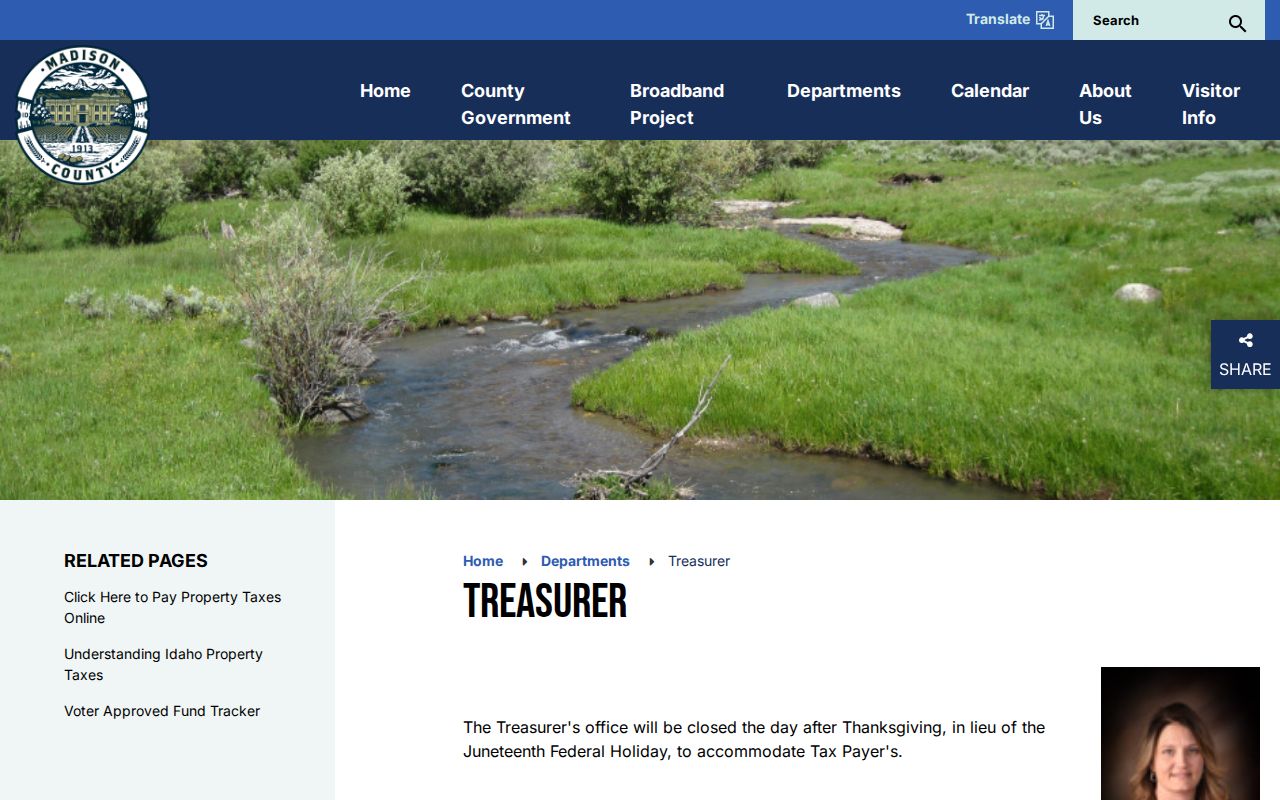
Payment status, notice status, the county deed, redemption, and a commissioners' sale are separate stages in Madison County. Never collapse them into one label.
Request Madison County Property Tax Records Offline
Online tools help, but they are not the only route. County offices sit at 134 E Main in Rexburg. Call 208-359-6200 for the Assessor, Treasurer, Clerk, or Board route. A written request under the Idaho Public Records Law should name the parcel, the exact tax years, the record type, and your preferred electronic delivery. Ask first whether mail, fax, or email is accepted. Request a fee estimate too. Idaho Code §§74-101–74-126 governs these requests. The Attorney General holds that Idaho residents receive the first two labor hours and the first 100 pages at no charge, subject to the law. Agencies generally grant, deny, or explain an inability to locate within three working days. A resident extension notice allows ten working days. Historical newspapers and library microfilm help verify publication, but the Treasurer and Recorder remain the official sources for Madison County property tax records.