
Documents Within Madison County Deed Records
Madison County deed records cover far more than deeds alone. The Clerk/Recorder indexes plats, easements, covenants, releases, ordinances, and annexations. Many other instruments sit in the same system. A deed itself records the terms of a transfer presented for recording. Mortgages and liens work differently. They may burden an interest in the parcel. But they do not replace the conveyance that moves title.
| Deed Type | What It Does | Common Use |
|---|---|---|
| Warranty deed | Conveys the stated interest with deed warranties | Ordinary negotiated transfer |
| Quitclaim deed | Conveys whatever interest the grantor holds | Interest cleanup or family transfer |
| Personal-representative deed | Transfers property through an estate representative | Probate sale or distribution |
| Tax deed | Records county title after the statutory delinquency process | Unredeemed tax delinquency |
| Plat or ordinance | Records subdivision or governmental land action | Development and annexation research |
Treat the document type as a clue, not a verdict. A broad portal filter can label a filing DEED while the detail page reveals it is actually a quitclaim or some other transaction, so the recorded image tells the fuller story.
Use the Madison County Recorder Fields Precisely
The recorded-document portal needs at least one criterion before it will run. Enter an instrument number and the search ignores everything else, but any additional fields you supply must match exactly. A document type alone will not work.
| Field | Best use | Rule to remember |
|---|---|---|
| Instrument number | Known deed or filing | Runs as the controlling query |
| Name | Grantor, grantee, or associated party | Use surname and partial given name |
| Description | Subdivision, block, lot, or tract | Match indexed wording |
| From / To date | Recording window | Dates operate as a pair |
| Document type | Narrow a valid query | Cannot stand alone |
Each result line shows the instrument number, recorded date, page count, received-from party, associated name, document type, and description. Open the detail view and the scanned image before drawing any conclusion about what the filing actually did.
Walk Madison County's Party Index Backward
The recorder's index calls its search field Name rather than grantor or grantee. Start with the party named on the most recent deed you have confirmed, then read the role line on each detail page. As surnames shift through the chain of title, keep the same legal description pinned in view.
- Find the current party's acquisition deed and record its instrument, date, and description.
- Read the transferring party from the image, not just the result row.
- Search that prior party for an earlier acquisition with the same land description.
- Repeat until the online evidence stops, then request older books or image series.
- Grantor
- The party conveying the stated interest.
- Grantee
- The party receiving that interest.
- Chain of title
- The linked sequence of instruments affecting the same land.
- Book/page and instrument number
- References used to retrieve a specific recorded item.
The 1909 Rexburg Quitclaim
Instrument 5 sits in the recorder portal as an example, recorded March 6, 1909. The detail page labels it a quitclaim/deed transaction and describes the land with Rexburg Original Townsite lot-and-block terms. One record that old proves the online archive reaches back to at least the early 1900s, though the county publishes no official cutoff date for its digitized holdings.
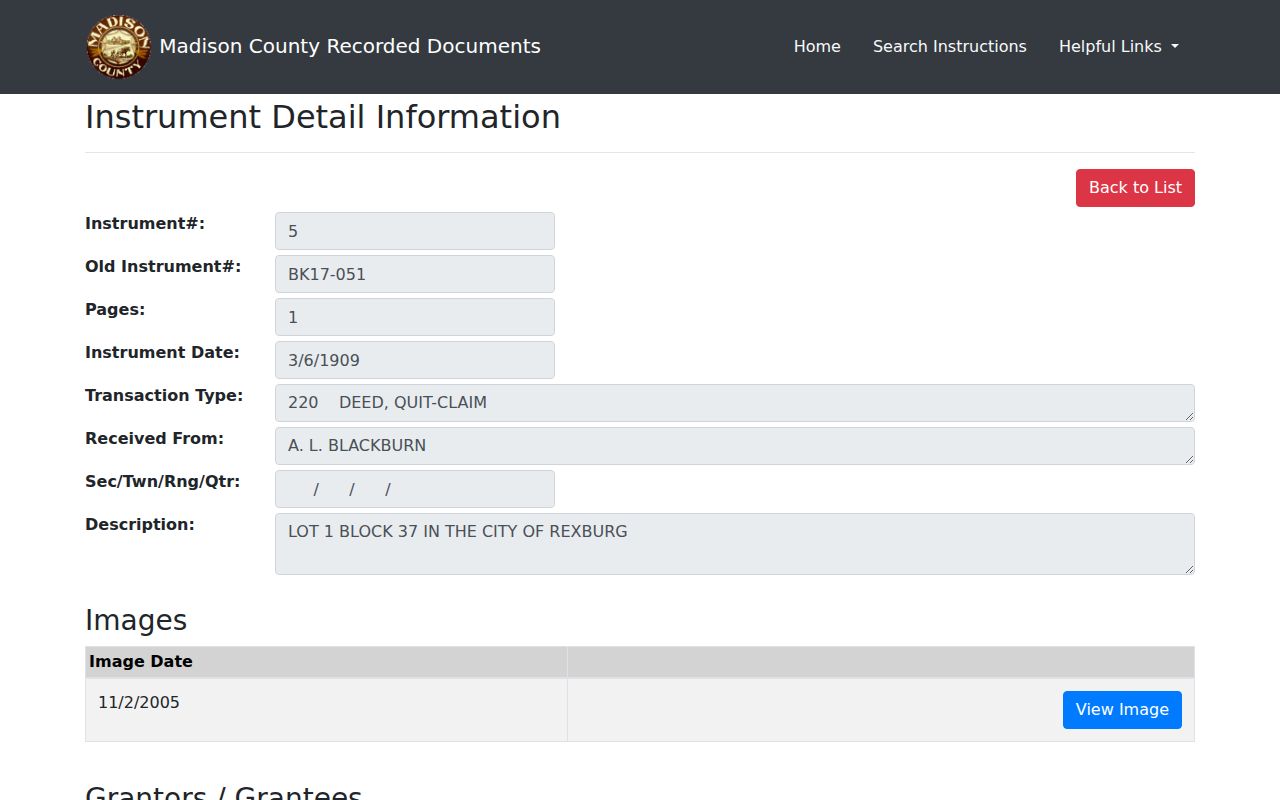
An image like this works best as a template. Pull the instrument number, the recording date, the exact document type, every party name, and the full legal description instead of boiling the record down to a former owner. Any one of those fields can unlock a parcel search later.
Note: A quitclaim moves only the interest the grantor actually holds, without the warranties a warranty deed would carry.
Madison County Plats and Easements
Deed records in Madison County cover far more than sales. A subdivision plat fixes lot and block labels. An easement can burden or benefit a parcel. A covenant may impose recorded restrictions. A release or reconveyance clears an indexed claim off the record. When the deed filter turns up nothing useful, search the legal description and the party names instead.
MRGIS related tables can bridge the gap with an instrument number. Carry that number into the recorder portal. Compare the map's subdivision name against the instrument description. If the GIS link is stale or missing, run a manual recorder search rather than assuming the filing never existed.
Estate and Court Deed Links
A court event can break a clean buyer-to-seller chain. A death, foreclosure, quiet-title case, partition, or tax proceeding can each move title outside an ordinary sale, and the paper trail splits between two systems. Search Idaho iCourt for the case index. Pull the full file from the clerk or kiosk. A lis pendens, an order, a decree, a sale record, a satisfaction, or a probate distribution may explain how the ownership actually shifted.
Then return to the recorder. The instrument recorded there gave the court action its public effect, and a docket entry alone never substitutes for the recorded deed or order, so keep the case number and the instrument number separate from one another.
Older Madison County Deed Records
Older deeds take patience. The FamilySearch Madison County collection spans deeds, homesteads, patents, tax deeds, probate, mining, and related records for 1894 through 1963, with deed images described as early as 1882. Coverage labels can mislead, though. Browse the volumes near the likely book and page before giving up on an entry.
Madison County dates to 1913, with offices opening in 1914 after the split from Fremont County. Pre-1914 chains may not live here. Fremont County, state, or federal custody can hold them, and the Idaho State Archives plus historic Rexburg newspapers can point the way. Certified copies still come from the proper custodian.
Request a Madison County Deed Copy
The portal image comes first when it is available. Save the instrument number anyway. A signed image token can expire. For a plain or certified copy, contact the Madison County Clerk/Recorder at 134 E Main, Rexburg, ID 83440, or call 208-359-6200 for routing. Whether you request a Madison County deed copy in person, by mail, or through a written public-record request, state the instrument number, party names, date, and legal description.
Idaho Code §31-3205 governs recorder charges. Statewide guidance covers paper copies, certification, deed recording, survey pages, and recurring electronic copies, but confirm the current Madison County cashier amount and delivery method before ordering. Ask for an estimate if staff must search older books or microfilm.
Recorded, not guaranteed. Madison County deed records show instruments accepted into the public record. They are not a title opinion, and unrecorded or misindexed interests may exist.
Verify Madison County Deed Images
The index row only summarizes a filing. The signed image holds the real authority. It carries the operative text, acknowledgments, exhibits, and the full legal description. It also shows exceptions a results table cannot show. Open the image while the link works and note the stable instrument number. When an image is absent, ask the Recorder for delivery. Do not treat the summary as final. Recording dates and execution dates are not the same thing. Compare them. Then check the subdivision, block, lot, tract, or metes-and-bounds language. Do this across consecutive deeds in the chain. Continuity in that description often proves more dependable than a modern street address. That matters when you rebuild ownership history in Madison County.
No Madison County Fraud Alert Was Located
Madison County publishes no official property-fraud or document-alert signup through its county sources. That gap does not mean a service will never be added. Owners worried about an unexpected filing can watch the recorder index. Keep the instrument details on hand. Contact the Clerk/Recorder directly about current options. A suspicious index entry still calls for the full image and professional advice. Name matches can point to unrelated people or entities. A document can be validly recorded without representing a sale at all. The recorder accepts deeds for recording but issues no title opinion through the public search.