
Trace Madison County Former Owners
Only recorded instruments build a dependable transfer sequence. Other record sets can hint at past owners, but the deed chain is what holds. The Madison County Clerk/Recorder index comes first. It lists names, dates, document types, and legal descriptions. Its live records reach back to an instrument dated 1909, though the county publishes no complete online cutoff, so that early date shows depth rather than full coverage of every year or image.
| Source | Years It Covers | Where Held | What It Shows |
|---|---|---|---|
| Recorded-document index | Observed from 1909 forward, completeness not stated | Madison County Clerk/Recorder online | Parties, instrument date, type, description, pages |
| Deed books and recorder files | Older and non-digitized material | Clerk/Recorder counter or request | Recorded images and book/page references |
| Historic land collection | 1894-1963 collection description | FamilySearch and Idaho State Archives | Deeds, patents, homesteads, tax deeds, probate |
| Plats and surveys | Record-specific | MRGIS, Recorder, and archive | Subdivision, lot, block, and boundary context |
A recent chain starts with today's parcel and latest deed. Then step back grantor by grantor. For an early Rexburg lot, keep the subdivision, block, and lot wording before hunting older names. Trails that predate county government call for a wider custody search, since Madison County was approved in 1913 and its offices opened in 1914.
A 1909 Rexburg Ownership Clue
One entry shows how old-property work pays off. The Recorder's 1909 instrument detail names the parties, the date, the page count, and the deed classification. It also lists a lot-and-block legal description. It is indexed as a quitclaim deed. A quitclaim moves only the interest the grantor held. It lacks the title assurances of a warranty deed.
The official instrument detail page also shows why an image outweighs a name-only hit. Its legal description still matches. Compare it with the current MRGIS subdivision and description fields. Do this even after the address has changed.
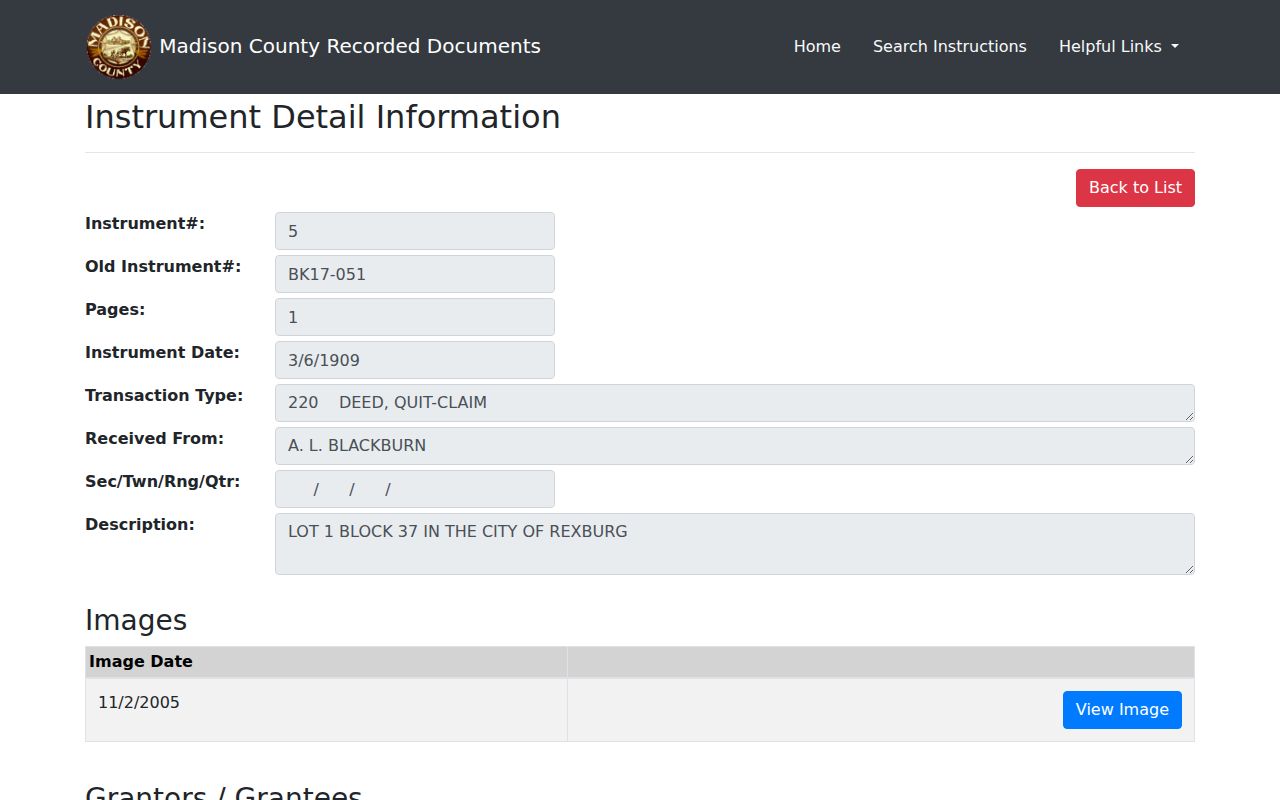
Save the instrument number and recorded date. Image links can expire, but those two keys make the source easy to pull again.
Legal Descriptions Preserve the Chain
Addresses work until they don't. Madison County deed and GIS records rely on legal descriptions instead. Subdivision names, blocks, lots, tracts, sections, township and range, and surveys all matter. They do the real work. The MRGIS parcel layer keeps description text in DESC1 through DESC5. Those fields can tie former owners to the same land. They hold up through a road rename, a new situs address, or a parcel split.
Copy the wording exactly as recorded. A label like an amended plat or a numbered subdivision division matters. Never collapse it to the base subdivision name. Compare assessed acres, GIS acres, and deed or survey acres separately when they differ.
Reconstruct Madison County Prior Owners
Work backward one transfer at a time. The recorder search accepts an instrument number, a name, a description, a document type filter, and a paired date range. Every entered criterion must match. An instrument number overrides the other fields, so start broad enough that a spelling or indexing quirk does not swallow a deed.
- Find the current parcel in MRGIS and preserve its exact parcel ID and legal description.
- Locate the current owner's acquiring instrument and read the grantor, date, and prior references.
- Search that grantor as an earlier grantee, using “Last, First” and a partial first name when useful.
- Repeat the link, checking each description against the same land rather than trusting names alone.
- Move to recorder files, FamilySearch, or archives when the online chain stops or an image is missing.
- Grantor and grantee
- The party conveying an interest and the party receiving it.
- Chain of title
- The ordered series of instruments affecting ownership of the same land.
- Reverse index
- An index route used to follow a named party backward through acquisitions.
- Quitclaim and warranty deed
- Different deed forms; a quitclaim offers no warranty about the interest conveyed.
- Legal description
- The land description that remains useful when a street address changes.
Madison County Probate Breaks
A clean buyer-to-seller chain sometimes stops cold. Estates, trusts, court decrees, and personal representatives all break the pattern. A probate order may never look like a sale. Current probate matters are indexed through Idaho iCourt. The actual files come from the courthouse kiosk or the clerk where the case was filed.
Search the recorder for a personal-representative deed or decree. Then keep the court case and the recorded document as separate sources. Historical FamilySearch material holds probate papers, wills, letters, orders, decrees, and estate registers. Vital records carry their own restricted-access rules. A deed naming an estate does not make those files public.
When Madison County Names Vary
Names hide past owners in many ways. Initials, punctuation, married names, trusts, estates, and business suffixes all blur the trail. Run separate focused searches. For individuals, the recorder recommends the “Last, First” pattern and allows a partial first name. For an entity, copy the exact name from the parcel card and recorded instrument. Check the Idaho Secretary of State business search when an LLC holds title.
Never treat a similar name as proof. Match the legal description, the instrument sequence, and the dates. GIS ownership can lag a newly recorded deed. Record both source dates rather than forcing them to agree.
Pre-County Owners Need Another Custodian
Madison County was carved from Fremont County. Voters approved the split in 1913, and county offices began work in 1914. A chain reaching before that transition may live with Fremont County, state, or federal land material. Never assume every early original sits in Madison County.
The Idaho State Archives preserve government records. FamilySearch lists Madison County land and probate records spanning 1894 through 1963, patents and homesteads included. The Madison Library District offers an Idaho Collection, research help, public computers, and Rexburg newspaper holdings that add notices and context. But a deed still proves the transfer.
Verify Madison County Past Owners
A solid chain-of-title result carries more than a column of names. For each transfer, keep the recording date, instrument number, deed type, and the parties involved. Record the legal description too. Note the book/page or image reference so the entry can be pulled again later. Flag any link you inferred rather than read. Instruments from courts, tax-deed actions, plats, ordinances, and probate can all reshape the history without resembling an ordinary purchase. So the deed records deserve a close look.
When the online index offers no image, the Madison County Clerk/Recorder can supply copies. The office sits at the county offices, 134 E Main in Rexburg. It takes calls at 208-359-6200 for routing, current copy fees, and access. Written Idaho public-record requests should name the exact instrument or date span. Idaho residents get the first two hours and first 100 pages free under the Attorney General's published guidance. Though exemptions and actual record-copy rules still apply.
Madison County Ownership Time Depth
Deed detail in Madison County's recorded-document portal reaches back to 1909. The county publishes no complete cutoff for its older records. Treat that year as a starting point, not a boundary. Search results, missing images, and early government boundaries can each create a false stopping point. That stopping point may hide earlier owners of record. The trail often continues in deed books, plats, patents, homesteads, and tax deeds. It also runs through probate holdings, newspapers, and the Idaho State Archives. Parcel numbers help, but the land description matters most. Following the same tract through each record keeps a property search honest. A complete historical title opinion still requires professional work. Public property records are discovery tools. They work best when you separate a recorded fact from a historical clue.
Lawful use. Trace former owners for house history, estate work, or property diligence. Never use these records to track, harass, or harm a living person.